ISO 27001 Certified ISPS Compliant


ISPS Compliance — Under Control, Without Delays
Digitize ISPS notifications, visitor approvals and secure gate access with vessel-linked verification, real-time oversight and up to 70–80% less manual coordination.
Ship2Port connects shipping agents, terminals and port authorities in one secure ISPS-compliant workflow — developed in collaboration with port security teams and aligned with real-world inspection requirements.
Request Demo
Start Free Trial
No credit card needed
TRUSTED BY LEADING PORT AUTHORITIES, TERMINALS AND MARITIME OPERATORS
Active internationally, with strong adoption across major European ports including Rotterdam, Amsterdam and Antwerp.




UNDERSTANDING THE CHALLENGE
ISPS Is Governance — Not Administration
Ports operate in increasingly complex environments where secure vessel access, stakeholder accountability and inspection readiness must be demonstrable at any moment. An average ocean vessel receives 5–10 visitors per port call. Across multiple terminals, agents and service providers, ISPS coordination quickly becomes fragmented.
Common ISPS Control Gaps
- No single verified source of truth for visitor and contractor access
- Approvals scattered across email, spreadsheets and paper
- Access lists not linked to live vessel or berth context
- Limited visibility across terminals and stakeholders
- Difficult to demonstrate ISPS compliance during audits
- Sensitive ID documents shared outside controlled systems
Fragmented coordination increases risk instead of reducing it.
Built for ISPS Security & Compliance Leaders
One Platform.
One Vessel-Linked Workflow.
Structured ISPS Governance.
Unified visitor access management, dual approval flows, real-time oversight and automatic audit readiness — fully traceable from request to inspection authority.
BENEFITS
Operational Impact per Stakeholder
Ship2Port standardizes ISPS workflows across the port ecosystem — delivering measurable operational control, up to 70–80% less manual coordination, and inspection-ready compliance.
Shipping Agents
Operate within a structured, vessel-linked approval environment instead of fragmented email coordination.
- Approve, reject or create ISPS notifications digitally
- Automatically route requests to the correct terminal or PFSO
- Receive real-time approval status updates
- Maintain a complete visit history per vessel call
- Eliminate manual tracking in spreadsheets
- Reduce ISPS-related coordination effort by up to 70–80%
More control. Less administrative friction.
Terminals & PFSO Teams
Maintain secure oversight of who is expected, approved and present on site — before visitors reach the gate.
- Pre-verified visitors before physical arrival
- Real-time overview of expected and active access requests
- Role-based ID visibility for security compliance
- QR-based validation for faster gate processing
- Automatic check-in and check-out timestamps
- Complete ISPS documentation archive
Operational flow without compromising security.
Port Authorities & Harbour Masters
Transform fragmented execution into structured, port-wide governance.
- Unified dashboards across terminals and quays
- Standardized workflows across the port community
- Vessel-linked traceability for every access request
- Clear accountability between agents and terminals
- Instant access to inspection-ready reporting
- Strengthened compliance oversight capability
Operate ISPS as structured governance — not reactive coordination.
Maritime Service Providers
Submit and manage access requests within a predictable, secure approval chain.
- Submit visit requests digitally in seconds
- Track approval status in real time
- Receive time-bound QR access passes
- Reduce waiting time at terminal gates
- Access vessels within a verified and compliant framework
Compliance without uncertainty.
Key features
A complete ISPS compliance framework for secure vessel access and structured port-wide governance.
Context-Driven ISPS Announcements
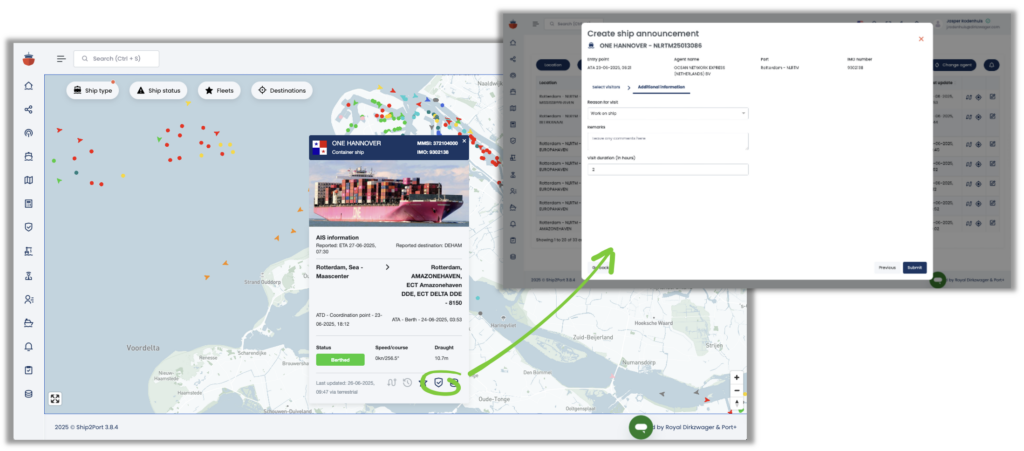
Create ISPS announcements directly from live vessel context — with automatic data linkage and correct stakeholder routing from the very first step. Instead of starting from a disconnected form, announcements are initiated within the vessel overview — fully linked to berth, ETA and agent data.
Start announcements directly from the vessel overview
Auto-populated vessel data (IMO, berth, ETA, terminal context)
AIS-validated vessel linkage
Automatic identification of responsible agent
Automatic routing to the correct terminal or PFSO
No duplicate data entry across systems
ISPS requests start where operations happen — not in disconnected forms.
Request
Request
Structured decisions
Auto-forwarding
Agent
Approved
Terminal / PFSO
Pending
Approval
Approval chain
Live
Dual approval
1
Submitted
Request created
2
Agent approval
Approved
3
Terminal / PFSO
Pending (real-time)
4
Final confirmation
Expected / On premises / Ended
Audit
Traceability
Submitted — Agent 10:12
Agent approved — 10:18
Terminal / PFSO pending
Audit proof
Actor + timestamp
Vessel + decision
Digital ISPS Approval Workflow
Standardize visitor and contractor approvals within a structured, vessel-linked workflow — eliminating fragmented email coordination and manual forwarding. Every request follows a clearly defined approval chain from submission to final confirmation.
Dual approval flows (agent + terminal/PFSO)
Real-time approval status updates
Structured accept / reject logic
Automated forwarding between stakeholders
Declaration of Security (DoS) support where required
Full traceability from submission to final decision
All stakeholders operate within one synchronized, real-time approval chain.
Pre-Gate Identity & Company Verification
Verification happens before physical arrival — not at the gate. Ensure that every visitor is identity-verified and company-validated before access approval is granted, reducing security risk and eliminating on-site delays.
Passport & government ID validation
Expiration and authenticity checks
Live biometric face matching
Anti-spoofing detection
Company registration validation
Configurable risk-based verification flows
Only verified individuals receive access approval.
Identity Document Verification
Passport and government ID validated for authenticity and expiration.
- Authenticity check
- Expiry validation
- Integrity verification
Biometric Verification
Live face verification confirms the person matches the identity document.
- Live photo capture
- Biometric face match
- Anti-spoofing detection
Company Verification
Business identity validated against official registries and compliance policies.
- Registry validation
- DUNS / registration check
- Policy & compliance rules
Real-time automated decision
Verified
Access approval unlocked
Flagged
Manual review required
QR-Based ISPS Gate Access
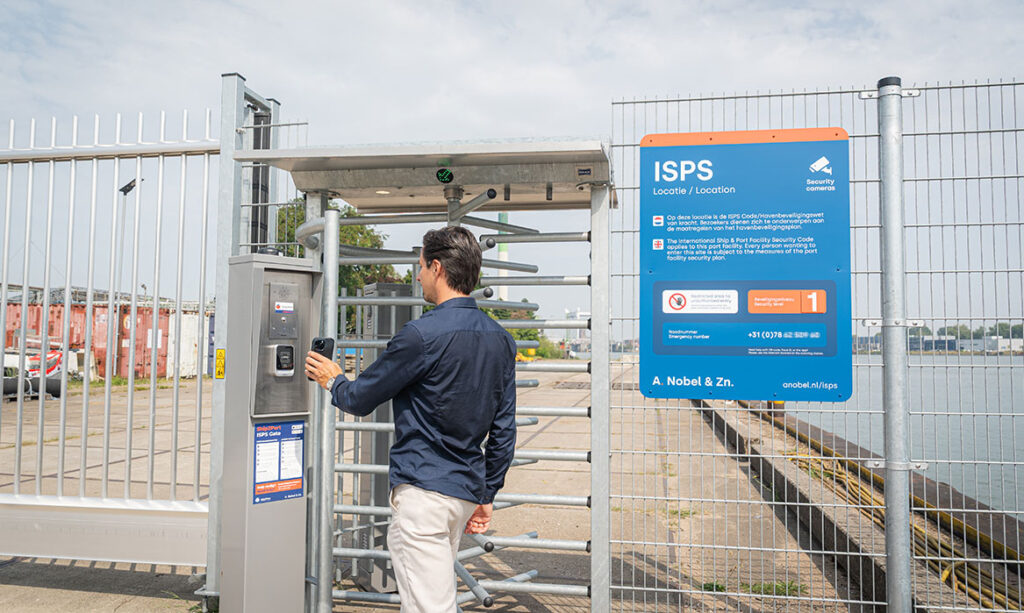
Transform approved access into controlled, time-bound physical entry — fully logged and traceable. Issue digital access credentials that integrate seamlessly with existing gate infrastructure, eliminating manual checks and reducing bottlenecks at terminal entry points.
Time-bound digital boarding passes
Secure QR-based access credentials
Scan-based validation at terminal gates
Automatic check-in and check-out logging
Real-time access status updates
Compatible with existing gate hardware
Verification happens before the gate — access is validated at the gate.
Real-Time Oversight & Dashboards
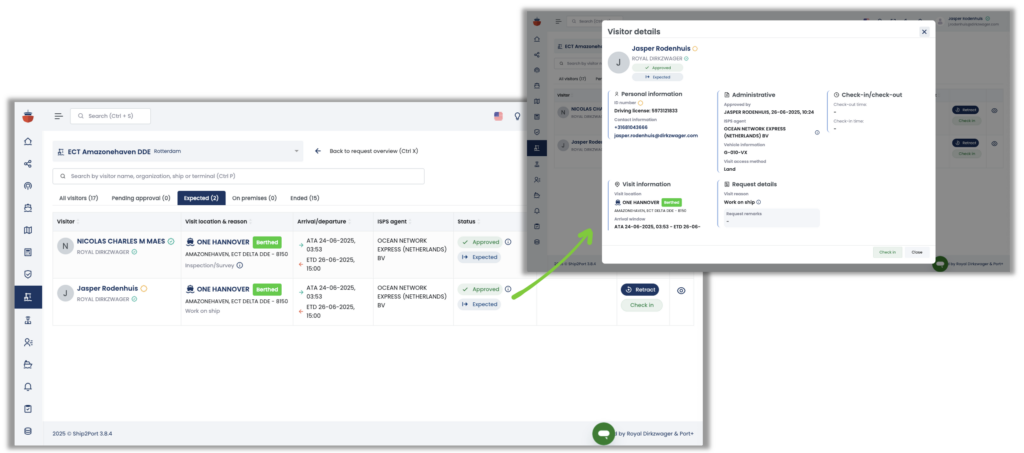
Maintain continuous visibility across vessels, terminals and stakeholders — with structured, filterable oversight in real time. Access live dashboards that provide operational clarity and security control across the entire ISPS workflow.
All stakeholders — agent, terminal, vessel and service provider — operate from the same synchronized, real-time source of truth.
Filter visits per vessel, terminal or date
View expected, approved, rejected or present visitors
Monitor arrival and departure timestamps
Track visitor name, organization and visit purpose
Link access requests to berth and vessel context
Monitor vehicle and license plate information
Always know who is expected, who is on site and who has left.
ACCESS
Access control
Role-based visibility per stakeholder
Visibility by role
Agent
—
status only
PFSO
—
ID access
Ops
—
no ID access
No ID forwarding via email
PRIVACY
Protected identity data
IDs stay inside Ship2Port — shared securely, never forwarded
Stored securely
Shared securely
Only authorized roles can view sensitive IDs
AUDIT
Audit & retention
Inspection-ready evidence for every approval
Actor + timestamp + vessel + decision
Retention
6 months
Privacy, Security & Audit
Operate ISPS within a secure, inspection-ready framework — with full traceability, controlled data visibility and structured retention policies. Every action, approval and access event is logged, encrypted and accessible for audit when required.
ISPS Compliant
GDPR / AVG Privacy-by-Design
ISO 27001 Certified
Role-based data visibility per stakeholder
Restricted ID access for non-security roles
No forwarding of ID documents via email
Encrypted data storage and transmission
Automatic logging of all stakeholder actions
Searchable digital compliance archive
Configurable retention policies (commonly 6 months)
Every approval is traceable — who approved what, when, and for which vessel.
HOW IT WORKS
How ISPS Access Is Controlled — Step by Step
Digitize and govern the complete access lifecycle — with clearly separated responsibilities across visitor, agent, terminal and compliance roles.
Submit visit request
Submit digitally and link the request to a specific vessel call.
Visitor / Service Provider
Auto-link vessel & berth context
Attach berth, ETA and vessel data via AIS-validated linkage.
Platform
Review and approve
Approve or reject on behalf of the master — within full vessel context.
Agent
Terminal-level security approval
Requests are automatically routed to the responsible terminal or PFSO for additional approval where required.
Terminal / PFSO
Identity and company verification
Validate identity documents and company details before physical arrival to reduce risk and prevent delays.
Verification Layer
Receive time-bound QR access pass
Once approved and verified, a secure, time-limited QR credential is issued digitally.
Visitor
Scan and log entry / exit
The QR code is scanned at the gate, automatically registering check-in and check-out timestamps.
Terminal Gate
INTEGRATIONS & DEPLOYMENT
Built for the Existing Port Ecosystem
Ship2Port ISPS is designed to integrate into existing port environments — without replacing infrastructure or disrupting established workflows.
It connects stakeholders within one secure, vessel-linked framework while maintaining compatibility with current systems.
Ship2Port Platform
Unified workflow
Vessel-linked data
Audit readiness
Port Systems
PMS & PCS connectivity where available
Vessel Data
AIS tracking, berth & ETA context
Terminal Infrastructure
Works with existing gate hardware
Dashboards & API
Security oversight & extensibility
Seamless system integration
The module connects to your operational environment without requiring infrastructure replacement or parallel systems.
- Port Management Systems (PMS)
- Port Community Systems (PCS)
- AIS vessel tracking infrastructure
- Existing terminal gate hardware
- Control room dashboards & APIs
No infrastructure replacement required. Ship2Port strengthens governance by standardizing workflows and delivering inspection-ready reporting within one controlled environment.
WHY SHIP2PORT
Structured ISPS Control for Modern Port Operations
Four reasons Ship2Port delivers clarity, control and accountability — not just workflow automation.
Structured ISPS Control for Modern Port Operations
Four reasons Ship2Port delivers clarity, control and accountability — not just workflow automation.
Vessel-Linked Architecture
Access decisions are anchored to live vessel calls and berth context. Security workflows stay aligned with operational reality — not disconnected approval chains or manual coordination.
Real-Time Oversight & Audit Readiness
Continuous visibility across stakeholders ensures inspection-ready documentation at any moment. Dashboards, approval logs and visit histories are searchable, structured and immediately accessible.
Built & Proven in Maritime Practice
Developed with maritime security stakeholders and deployed in major European ports — backed by Royal Dirkzwager expertise.
ISPS Compliant
GDPR / AVG Privacy-by-Design
ISO 27001 Certified
Bring Structure to Your ISPS Access Process
Ship2Port connects shipowners, agents, terminals, service providers and port authorities within one secure, vessel-linked workflow.
Reduce manual coordination.
Improve oversight.
Be inspection-ready at any moment
Deployed in major European ports
Built within an ISO 27001 certified security framework
Make and manage ISPS notifications with Ship2port
Safer, faster and more efficient ISPS notification
The ISPS module in Ship2Port was developed by Royal Dirkzwager with the support of the Port of Rotterdam Authority’s port security team and a number of industry associations. By using the ISPS module a lot of time can be saved and safer and AVG- and ISPS-proof work can be done. The ISPS module is available for seagoing vessels expected or berthed in the ports of Amsterdam and surroundings, Rotterdam and Antwerp and for terminals in the same regions.
Visiting a seagoing vessel in a port is allowed only if the ship’s agent, on behalf of the master, gives permission. This is one of the security requirements of the ISPS code. An ocean vessel receives an average of 5 to 10 visitors per port call. Receiving ISPS notifications, approving and rejecting them, providing feedback and then informing terminal and ship, and concluding the administration takes a lot of time. With Ship2Port, Royal Dirkzwager has automated this process.
Visitors register their intended visit via the ISPS module in Ship2Port or via the Ship2Port app. The notification then reaches the ship’s agent or, in the case of a terminal visit only, the terminal. Once approved by the agent, it is forwarded to the terminal(s) where the ship docks. If that also approves, the visitor knows he can visit the ship without any problems.


Automatic feedback
The platform automatically links the status of the notification back to the applicant, both via the Ship2Port dashboard in an Internet browser and via the app. All stakeholders (shipowner, ship, agent, terminal and visitor) have the same real-time information. A terminal has real-time overview of visitors expected and present at the terminal. A supplier thus knows in real-time that his employee has been granted access for maintenance on a ship. And the agent and shipowner know that the ship is currently being serviced.
Benefits Visitor
ISPS in Ship2Port gebruik je, wanneer je:
- When you want to board ships, perform a certain service on board and/or sell a product or service
- When you want to save time and paperwork when registering ships
- When you want to avoid unnecessary loss of time at the terminal gate
- Want to ensure the safety of your ships and keep control over the visits of suppliers, technicians and family members of shipboard personnel
- Have an up-to-date and reliable overview of approved and rejected visits.
Benefits shipping agent
- Notifications and updates via phone or email are a thing of the past.
- No more paperwork and spreadsheets
- ISPS notifications approve and reject, but also create your own
- Clear overview of expected:
- Visitor, organization, reason for visit, arrival and departure time, type of ID and last 3 digits ID number and license plate
- Integrated background validation of organization, visitor and vehicle (end 2025)
- All stakeholders (visitor, agent, terminal and ship) have the same up-to-date data
- Real-time filterable overview of visits per day, per ship or terminal, check-in and check-out times and more for overview and for the purpose of controls
- Complete history of all stakeholder actions for the applicable retention period of 6 months
- ISPS-proof, full compliance with latest requirements
- AVG-proof processing of personal data: e.g. agent does not see ID, terminal does and IDs do. e.g. agent does not see an ID, terminal does and forwarding IDs by e-mail is a thing of the past
- Last but not least, when the agent starts working with Ship2Port, it also becomes more efficient and safer working for visitors, terminals and shipping companies.
Benefits terminal
- Notifications and updates via phone or email are a thing of the past
- No more paperwork and spreadsheets
- ISPS notifications approve and reject, but also create their own for own terminal
- Clear overview of to-be-expected:
- Visitor, organization, reason for visit, time of arrival and departure, type of ID and ID number and license plate
- Integrated background validation of organization, visitor and vehicle (end 2025)
- All stakeholders (visitor, agent, terminal and ship) have the same up-to-date data
- Real-time filterable overview of visits per day, per ship or terminal, check-in and check-out times and more for overview and for the purpose of checks
- Complete history of all actions of stakeholders during the applicable retention period of 6 months
- ISPS-proof, full compliance with the latest requirements
- AVG-proof processing of personal data: agent sees e.g. no ID, terminal does and IDs do not. e.g. agent does not see an ID, terminal does and forwarding IDs by e-mail is a thing of the past
- Last but not least, when a terminal starts working with Ship2Port, it also becomes more efficient and safer for visitors, agents and shipping companies.
Experience the power of Ship2Port for yourself now
Ship2Port is the only platform with which both shipowner, ship, agent, terminal and visitor work. This switches quickly and provides great efficiency. Experience the power of Ship2Port for yourself now and get more information or request a free trial.