Fragmented updates
Arrival information is spread across emails, spreadsheets, carrier portals and public tracking tools, making it harder to use consistently in day-to-day logistics workflows.


For Cargo Owners & Logistics Providers
Stay informed on vessel locations, expected arrivals and schedule changes to support inbound cargo planning and logistics coordination.
Why this matters
Cargo owners and logistics providers often depend on fragmented updates to understand when relevant vessels will arrive and how this affects inbound cargo planning.
Arrival information is spread across emails, spreadsheets, carrier portals and public tracking tools, making it harder to use consistently in day-to-day logistics workflows.
Teams spend time chasing updates and aligning information across stakeholders, planning teams and internal systems.
Limited vessel visibility makes planning slower, more reactive and less reliable when cargo-related decisions depend on accurate arrival expectations.
How Ship2Port helps
Ship2Port brings vessel tracking and liner schedule visibility together in one workflow, helping your teams plan ahead, reduce unnecessary follow-up and use relevant insights more effectively in logistics planning processes.
Key benefits
Ship2Port helps cargo owners and logistics providers stay ahead of vessel arrivals, reduce manual follow-up and support planning with more confidence.
Follow vessel positions and expected arrivals in real time to prepare earlier and respond faster in your cargo planning process.
Combine liner schedule data with live vessel movements to support more reliable planning and coordination.
Bring vessel and schedule visibility into your existing TMS, 4PL or internal planning workflows through API-based integrations.
Avoid switching between emails, spreadsheets and tracking tools by working from one consistent source of visibility.
Use cases
From following inbound vessel arrivals to supporting planning across teams and systems, Ship2Port helps organisations stay informed and act earlier.
Follow the vessels relevant to your inbound cargo planning and stay informed on expected port arrivals, so your teams can prepare next steps earlier.
Give logistics, operations and planning teams a shared view of vessel movements and liner schedules to reduce back-and-forth and coordinate faster.
Bring vessel movements and schedule insights into your existing planning environment through API-based integrations to support coordination, follow-up and decision-making.
Start with the vessels that matter most today and expand your tracking setup as your organisation needs visibility across more shipments, suppliers or trade lanes.
Product overview
Use Ship2Port to follow relevant vessel movements, expected arrivals and liner schedules in one clear workflow.
Give logistics and planning teams a straightforward view of where relevant vessels are, when they are expected to arrive and how schedules evolve, so they can prepare earlier, coordinate with more confidence and use those insights in existing planning processes.
See where relevant vessels are and how they are moving throughout the journey to support cargo-related planning decisions.
Monitor updated arrival expectations to support earlier planning, coordination and follow-up around inbound cargo flows.
Use schedule data alongside live vessel information to better understand changes, timing and downstream impact.
Bring relevant vessel and schedule visibility into existing TMS, 4PL or internal planning environments through API-based integrations.
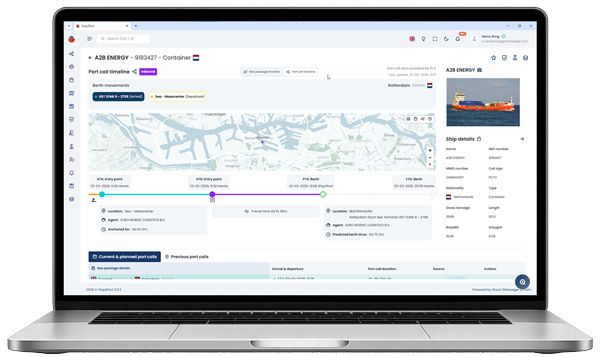
Ship2Port helps cargo owners and logistics providers follow relevant vessel movements, support inbound cargo planning and use liner schedule visibility more effectively in existing logistics workflows.