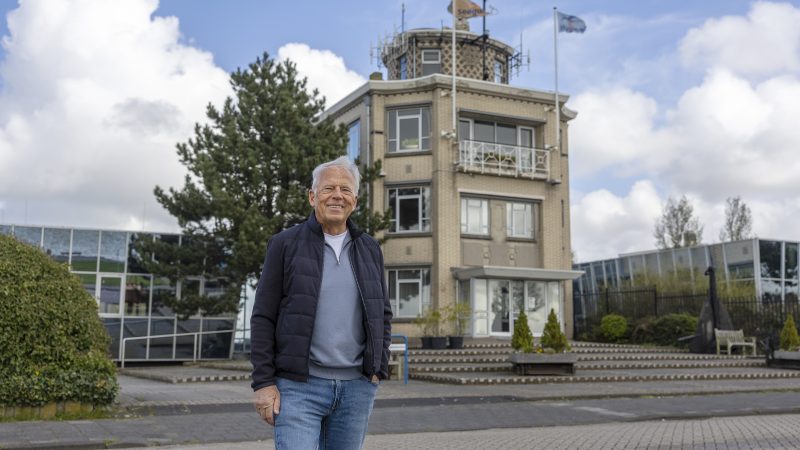
Robert Bokx, founding father of the vessel database: ‘Datadirk runs like a common thread through my life’
Maassluis – April 18, 2026 – Royal Dirkzwager said goodbye this spring to its Datadirk computer system, an IT system with a vast vessel database that helped make Dirkzwager a major maritime service provider. Programmer and mathematician Robert Bokx, now 72, designed the system and was responsible for its maintenance throughout the more than 38 years it was in use.
Programmer and mathematician Robert Bokx, now 72, was the designer of the system. Photo: Dennis Wisse.
‘Datadirk has run like a common thread through my entire life,” says Bokx. “Of course it’s remarkable that the system functioned for so long, but it’s good to say goodbye to it now. For the first time in all these years, I can switch off my phone at night. All that time I had to be available 24 hours a day in case there were malfunctions with Datadirk. If my mobile phone battery ran out, I would get slightly stressed, because I always had to be reachable for Dirkzwager.’
No Wi-Fi
In all those years, Bokx was ultimately called only once for a real emergency: in 2023, when a cyberattack brought Dirkzwager’s Windows network to a standstill. Everything was down, except for Datadirk, which ran on Linux and remained unaffected and operational.
‘That was one of the few times I was called,’ he says. ‘I was on a boat at the time, travelling from New Zealand’s South Island to the North Island. My phone battery was almost dead, and there was no Wi-Fi on board. As soon as we reached shore, we went straight to the hotel and I logged into the Datadirk system, which was still functioning properly. I was then able to provide all the customer files and email addresses, so everyone could be informed.’
Very happy
Datadirk continued to run in parallel for some time alongside the new replacement system, Ship2Port, which Dirkzwager also developed in-house. At the end of March, the moment finally came and Datadirk was officially shut down. Ship2Port then went live. The system is now active both at Dirkzwager in Maassluis and at the company’s branch in Antwerp.
“I’m genuinely very happy with the new system,” says Bokx. “Previously, there was never a good alternative, and such a heavy dependence on me as a person is obviously not ideal. I had been saying for quite some time that a replacement was needed.”
Saying goodbye to Datadirk does not mean Bokx has stopped working. On the contrary: the rise of new technologies and the rapid developments in Artificial Intelligence still keep him busy and make him curious about all the new possibilities, he says.
‘For the first time in years, I now switch off my phone at night.’
Back in the late 1980s, when the fourth-generation programming language Unify/Accel emerged, I thought: this is going to change our lives. That’s also what we started using for Datadirk, which went live in 1987. We were able to build new applications much faster, whereas before that it had been very labour-intensive, and the user interface was much better.’
‘We are experiencing a similar breakthrough now with the rise of AI. I find it very exciting and fascinating to witness this AI revolution; everything is accelerating because of it. My son is co-founder of a company that uses AI for legal services. I work closely with them. They value the many years of experience I bring, and I’m happy to be working on something new again. It keeps you sharp.’
Incidentally, in all those years Bokx was officially employed by Dirkzwager for only one year: in 1996, when the Datadirk system had to be installed in Hamburg, Vietnam, Jakarta, and in six ports in South Africa. ‘Yes, those were wonderful projects.’
While remaining consistently connected to Dirkzwager as an independent contractor, Bokx simultaneously built up his own IT consulting companies, Integrity and Conclusion, both of which he eventually sold. Conclusion, the last company he sold in 2006, now employs 3,800 people.
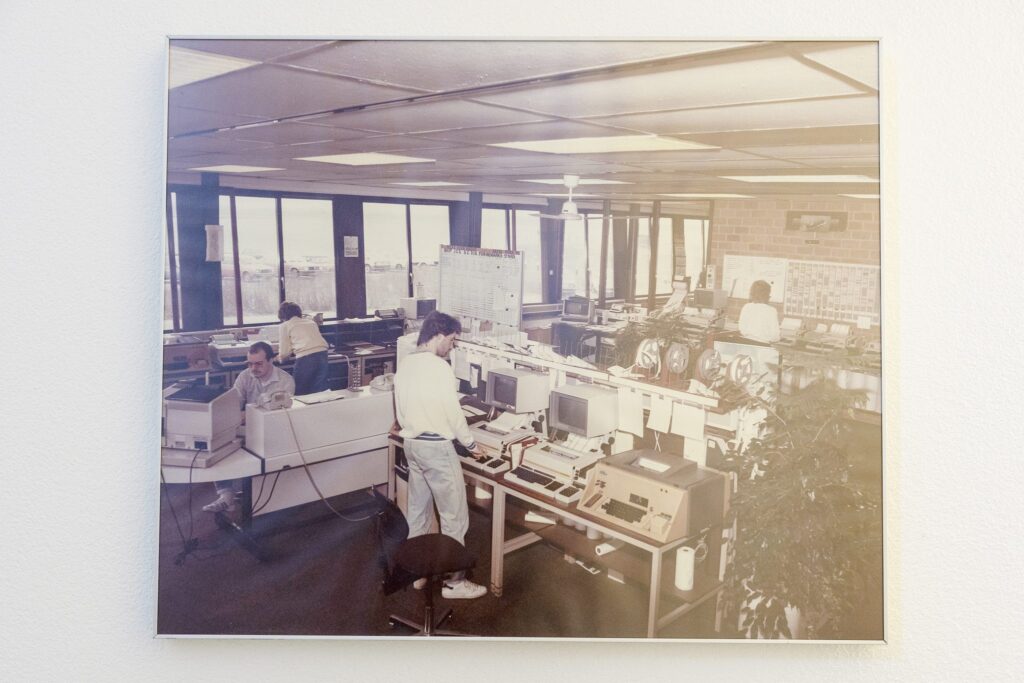
The Dirkzwager office in the 1980s. Photo: Royal Dirkzwager Archives.
Binoculars
In fact, not that much changed in Datadirk’s architecture over the years, although the system was expanded and improved. By the late 1980s, Dirkzwager had become one of the key links in monitoring arriving ships through the system. Whereas ship arrivals and departures in Hoek van Holland had previously been tracked using binoculars, this was gradually taken over by automated systems and links between radar systems, telexes, and databases.
‘Datadirk was far ahead of its time. Thanks to smart integrations and up-to-date data, Dirkzwager was able to provide tailor-made services to its customers, and there was strong interest in that from the very beginning. Salvage companies, as well as tug and pilot services, shipowners, and shipping agencies, are all interested in it. There are still many opportunities in customization, especially with developments in AI.’
Ship2Port replaces Datadirk
After nearly forty years, Royal Dirkzwager’s new digital system, Ship2Port, has replaced the long-standing Datadirk system. The core principles of the new platform have changed little: it is designed to provide everything needed to monitor maritime activities in real time, supplemented with up-to-date port data, sailing schedules, and berth information.
The system is also integrated with port community systems and the Automatic Identification System (AIS), which automatically identifies and tracks ships worldwide via VHF radio waves. In this way, all international ship movements can be closely monitored: from expected arrival times to port calls, departure times, berth allocations, routes travelled, and final destinations, as well as ship type and ownership information. Based on all this data and traffic information, planning becomes easier and adjustments can quickly be made when changes occur.
The system also provides access to a complete database of ship information, including ownership and management details, as well as technical specifications such as dimensions, engine type, and capacity.
First come, first served
Besides being faster and more advanced, the new system also offers Dirkzwager more opportunities through the use of AI, as well as through specialized applications and tailor-made solutions.
For example, Dirkzwager is participating in the so-called Mission project (Maritime Just In Time Optimisation), which aims to reduce ship emissions. Port visits are often handled according to the “first come, first served” principle, which regularly leads to waiting times, unnecessary fuel consumption, and extra emissions. Through Mission, port calls are coordinated digitally on a just-in-time basis, helping to minimize both emissions and waiting times.
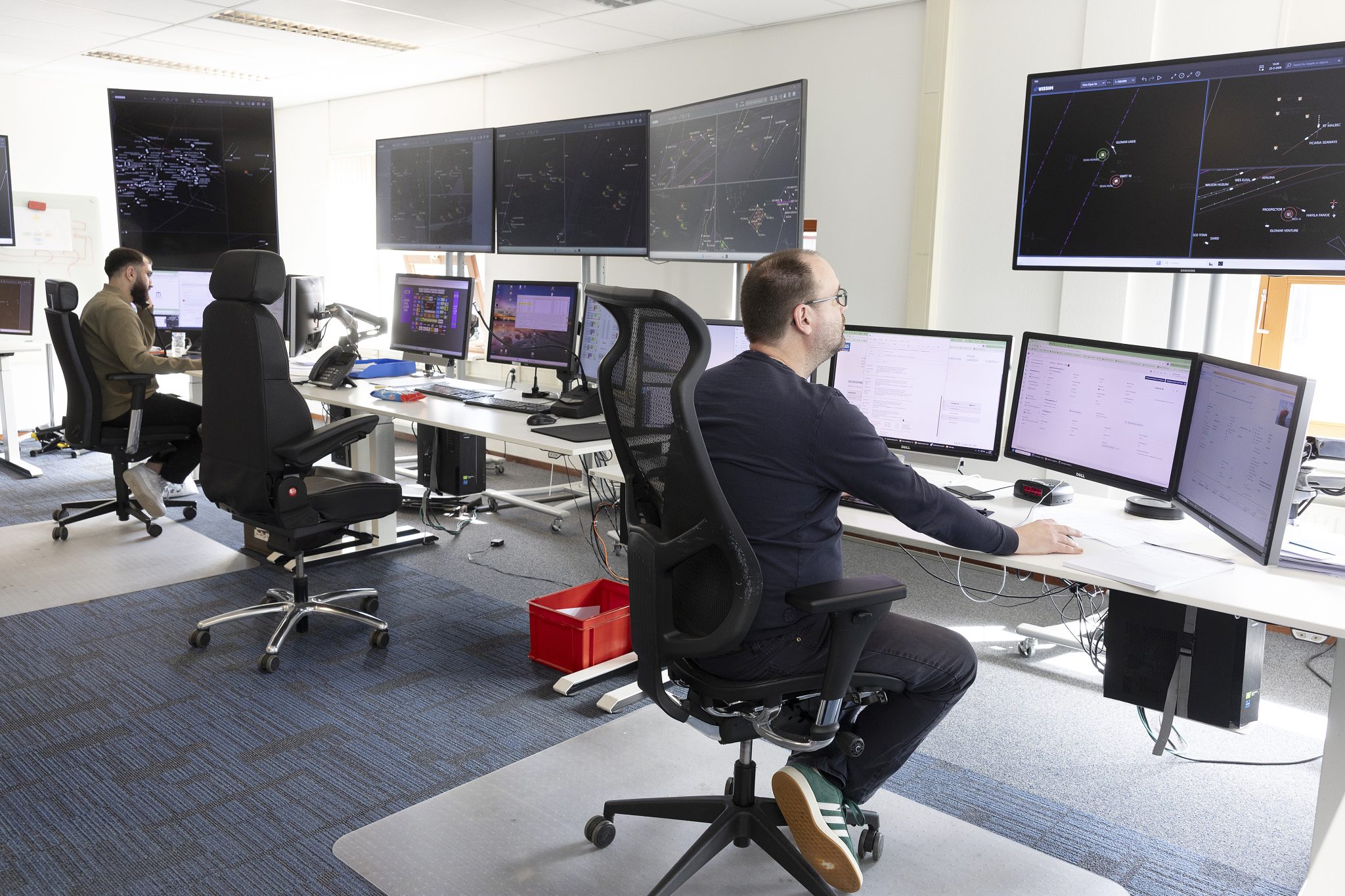
Dirkzwager now uses the new system, Ship2Port. Photo: Dennis Wisse