


Start an ISPS announcement
Receive a request linked to a specific port call, or initiate one yourself when needed (also on behalf of contractors or users without an account).
ISPS for Shipping Agents
Digitize ISPS notifications and approvals for each port call in one controlled workflow.
Replace fragmented emails, spreadsheets and manual forwarding with one port call-linked workflow, so shipping agents always know what is approved, what is pending and what still needs action.
THE CHALLENGE
Shipping agents manage multiple port calls under time pressure. When coordination happens through inboxes instead of a shared workflow, visibility disappears and small changes quickly turn into operational risk.
Email, calls, WhatsApp and forwarding. The “single overview” disappears immediately.
Approved, pending and rejected are not visible to everyone working on the same port call.
Routing to the correct terminal or PFSO becomes a task in itself, with follow-up and rework.
When updates arrive last-minute, it is hard to know what is final and what still needs action.
The result is predictable: more coordination work, a higher chance of missed updates, and less confidence that the visit record is complete. Under ISPS, that combination is uncomfortable.
THE SOLUTION
Ship2Port turns ISPS coordination into a shared, port call-based process. Everyone works from the same request, the same status and the same visit record, without manual tracking.
Vessel context is the anchor. Requests, updates and decisions stay tied to the port call.
One shared status view. Agents, terminals and vessels see the same approval state.
Routing is built in. Requests reach the correct terminal or PFSO without forwarding.
The visit record stays complete. A clear history per port call supports handover and audit.
HOW IT WORKS
Ship2Port structures ISPS the way shipping agents actually work, so you stop coordinating across email, calls and spreadsheets and keep every port call under control.
Receive a request linked to a specific port call, or initiate one yourself when needed (also on behalf of contractors or users without an account).
Once the agent approves the request, it’s routed automatically to the correct terminal. No manual forwarding and no guessing who to send it to.
Approvals, rejections or feedback appear immediately in your shared status view, without phone calls or inbox checks.
See expected visitors, organizations, IDs (and vehicles where applicable), time windows and visit purpose, plus a full action history.
KEY BENEFITS
Built for shipping agents managing ISPS under time pressure. Ship2Port replaces fragmented communication with one structured, port call-linked workflow.
Approve, reject or create ISPS notifications without email or phone coordination.
Requests go directly to the correct terminal or PFSO, without manual forwarding.
Agents, terminals and vessels work from the same real-time data, eliminating duplicate updates and manual tracking.
Clear insight into visitors, organizations, IDs, vehicles and time windows, structured per ship.
Submit and manage ISPS notifications even for users without an account.
Every action is logged and traceable, aligned with ISPS and GDPR/AVG.
KEY FEATURES
Everything is organized per port call: one shared overview for status and follow-up, and one detailed view for verification, updates and a complete visit record.
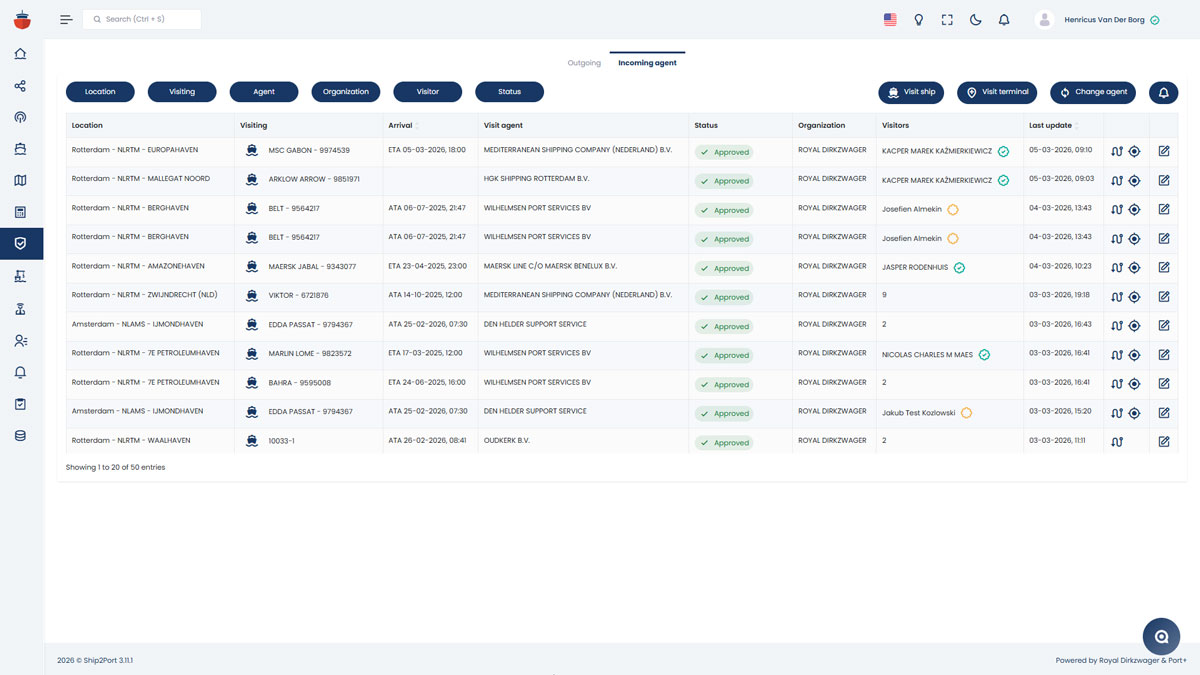
See all ISPS announcements linked to your port calls in one structured overview. Instantly spot what is approved, what is pending and what still needs action.
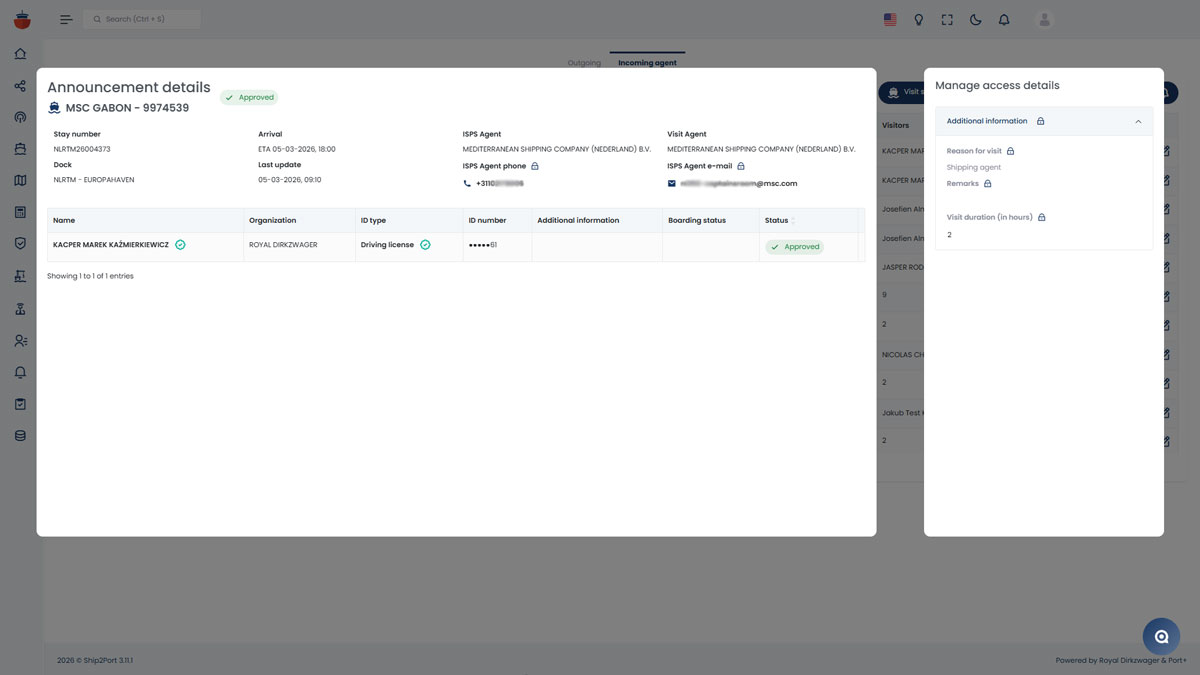
Open any announcement to review visitor details, verify information and manage updates. Every change stays linked to the port call with a clear history for handover and audit.
SECURITY & COMPLIANCE
Operate ISPS within a secure, inspection-ready framework. Identity data stays protected, approvals remain fully traceable, and visit records are retained according to defined policies.
Every approval remains traceable: who approved what, when, and for which vessel.
Ship2Port connects shipowners, agents, terminals, service providers and port authorities within one secure, port call-linked workflow.